
Finding reliable China top Pins Badge manufacturers requires more than choosing the lowest quotation. A strong supplier should combine proven production experience, stable quality control, clear communication, and practical export knowledge. This matters whether you need enamel pins for retail, company branding, events, clubs, or promotional campaigns. The best manufacturers usually explain their materials clearly, including zinc alloy, iron, soft enamel, hard enamel, plating, and backing options. They should also provide accurate drawings, pre-production samples, and realistic delivery schedules.
A useful search begins with verified B2B platforms, trade fairs, manufacturer websites, and referrals from experienced buyers. Look for factory photographs, quality certificates, production videos, and detailed case studies. These details do not guarantee perfection, but they help reveal how a supplier works. Ask about mold fees, minimum order quantities, color accuracy, packaging, inspection procedures, and shipping terms. A dependable factory will answer directly and identify possible design problems before production begins.
There is no single “best” manufacturer for every project. A supplier serving large corporate orders may not suit a small custom collection. Sample quality can also differ from mass production, so an independent inspection may be worthwhile. I have found that small details, such as uneven edges, loose clasps, or dull plating, can affect customer trust. This guide explores where to find China’s top Pins Badge manufacturers and how to compare them with greater confidence. Some recommendations may still require personal verification, because supplier information can change over time. The careful buyer checks twice before approving the final order.
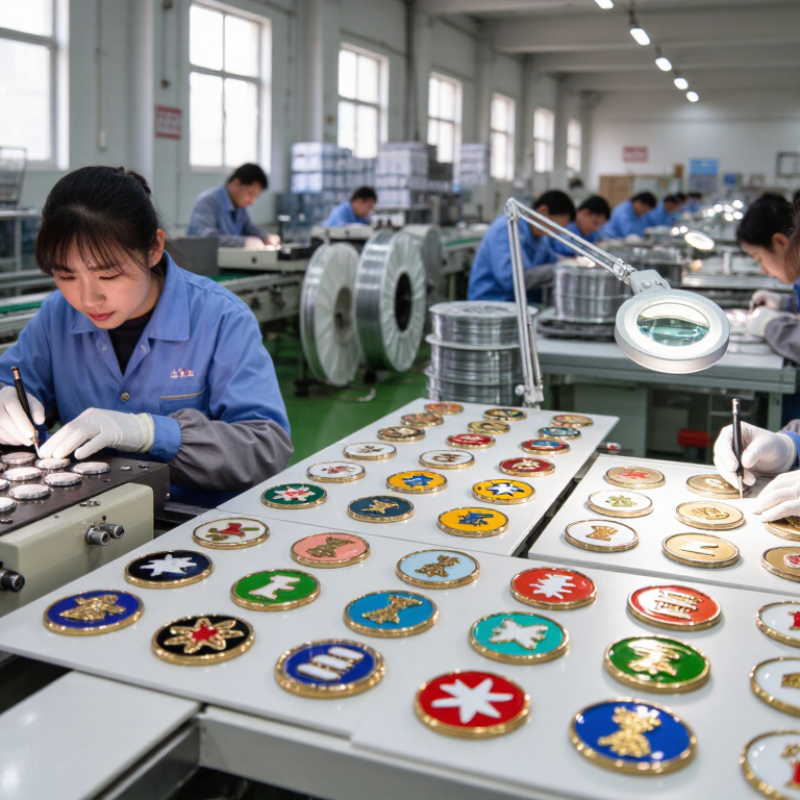
China’s pin badge supply base is not one uniform industry. Buyers usually meet four manufacturer types: OEM factories, specialist enamel workshops, metal-stamping plants, and trading companies. OEM factories handle artwork, molds, plating, color filling, assembly, and packing under one roof. Specialist workshops focus on hard enamel, soft enamel, die-struck, or printed badges. Metal-stamping plants excel at crisp relief and repeated production. Trading companies coordinate several workshops, which can help small buyers but may reduce process visibility. That distinction matters.
UNIDO’s International Yearbook of Industrial Statistics 2024 reports that China produced about 31.6% of global manufacturing value added in 2023. This scale supports dense supplier networks, fast tooling access, and competitive batch pricing. However, manufacturing volume does not prove badge expertise. The ISO Survey 2023 places China among the leading countries for ISO 9001 certifications, but buyers should verify the actual workshop behind the certificate. Ask for recent samples, mold tolerance records, plating specifications, and production videos.
In practice, I separate suppliers by the process they control. A specialist factory may deliver better color consistency, while an integrated OEM can simplify inspection and shipping. Trading companies may handle unusual combinations, such as recessed artwork with a clear epoxy dome. Still, request a pre-production sample. Check metal composition, edge finish, pin attachment, and packaging dimensions. Small defects show clearly under office lighting. I once underestimated that detail. The sample looked acceptable outdoors, but uneven plating became obvious indoors. Compare quantities, remake policies, lead times, and inspection methods before choosing a supplier.
OEM factories manage artwork, molds, plating, coloring, assembly, and packing. Specialist workshops focus on enamel, stamped, or printed badges. Metal-stamping plants create crisp raised details. Trading companies coordinate several workshops. Visibility may be lower.
Use identical specifications for every quotation. Separate mold fees, plating, backing, packaging, and shipping costs. Request prices for 100, 500, and 1,000 pieces. A low unit price may hide setup charges. I once missed packaging costs. That changed my budget.
Ask for material type, badge size, finish, colors, backing, quantity, and lead time. The quotation should list sample charges and mold fees separately. Confirm shipping terms and remake policies. Vague pricing creates avoidable confusion.
Yes. Request a pre-production sample before approving bulk manufacturing. Inspect it under office lighting and natural light. Check plating, edges, enamel surfaces, pin attachment, and artwork alignment. Outdoor light can hide defects. That happened to me.
Ask for recent samples, factory photos, production videos, and inspection records. Confirm which processes happen in-house. Verify the workshop behind any quality certificate. Fast communication does not prove consistent manufacturing. Samples matter more.
Ask about unusual shapes, multiple colors, glitter, recessed artwork, and custom backing cards. Request a digital proof and a physical sample. Check color accuracy, edge sharpness, clasp strength, and logo alignment. Some suppliers promise everything. Their samples may disagree.
Match the minimum order with your sales plan and storage capacity. Request tiered pricing for several quantities. A larger batch may reduce unit costs but increase unused inventory. Test a small batch when quality remains uncertain. It is slower, but safer.
Check uneven plating, sharp edges, weak pin fittings, color gaps, and damaged packaging. Compare the finished badge with the approved artwork. Ask how defects are counted, replaced, and documented. Keep all specifications in writing. Verbal promises fade quickly.
Finding the right China Pins Badge manufacturer requires more than comparing online listings. Buyers should first understand the main supplier types, including factory-direct producers, custom badge workshops, trading companies, and manufacturers specializing in specific materials or finishing techniques. Reliable suppliers can be found through business directories, trade platforms, industry exhibitions, referrals, and direct inquiries. During the search, check their experience, product range, communication quality, certifications, factory information, and customer service.
Before making a decision, evaluate sample quality, material durability, color accuracy, plating, enamel or printing details, production equipment, quality-control procedures, and delivery capacity. Compare quotations carefully, considering minimum order quantities, mold or setup fees, packaging, shipping, and customization options. Request samples and clear production specifications before placing an order. Finally, verify the supplier’s business details, inspect or audit the facility when possible, review agreements carefully, and select the manufacturer that offers the best balance of quality, price, flexibility, reliability, and long-term support.
